
introductionWith the React setups landscape changing so quickly, choosing which system to use can be difficult.
With a rapidly evolving field, how do they compare with performance, DX, and architecture?
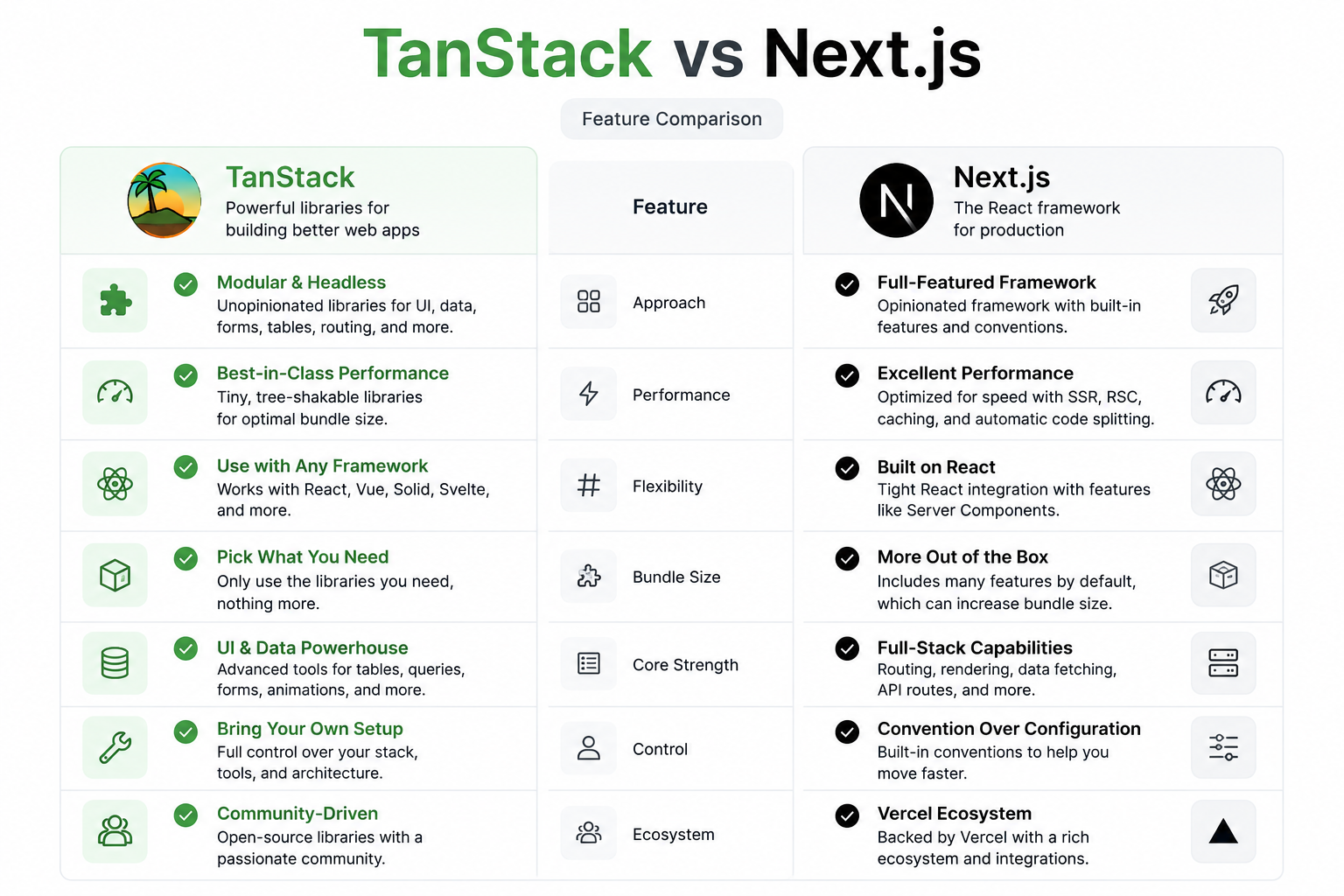
This paper compares two leading full-stack React systems: Next.js (Next.js 16) and TanStack Start, with next.js being a staple of the framework landscape and TanStack Start quickly emerging as a worthy alternative, challenging some of the core beliefs of Next.js.Next.js and Tan Stack Start: though they share a mission to enable the building of stable React apps, they are quite philosophically dissimilar. .
Next.js: The Platform PlayNext.js was initially developed by Vercel to optimize for their idea of the web.It is built around a server-first approach, platform integration, and a set of prebuilt optimizations that perform their best on the Vercel hosting platform.The premise of the setup is most of the web pages are static or close-to-static, which Server Components represent out-of-the-box; and that interactivity is a permission-based option.The setup generally approaches architecture through a 'hand-holding' approach to build a "single experience built for them" . (original not yet discussed).(Can use any Acronyms before Introduction).
Now you begin your business report to your company by writing the Introduction.TanStack Start takes a different approach, optimizing for developer control and correctness, favoring type safety through application, explicit over implicit configurations, composable primitives, deployment freedom.It's guiding principle is that developers know best how their applications should work, and server rendering should be an explicit optimization.While it offers powerful primitives, it tries to get out of the way of the developer to be predictable.The architecture of each structure has an important role in the setup development life cycle as well as on their performance and flexibility.
Build Pipeline Next.js deprecaded Webpack as its stable default bundler to Turbopack in Next.js 16.But Turbopack while it finally brings a considerable performance increase (2-5x faster production build, and up to 10x faster Fast Refresh), exposes a limitation with its high integration in the next.js architecture.We were only able to bypass a single page.
TanStack Start is built on Vite, which brings native gains like faster development server startup, faster HMR, and the broader Vite plugin ecosystem access.This common tooling standard approach is more portable and familiar across projects .Word.Next.js ships with a pretty large runtime which is part of what makes Server Components, server side caching, and automatic optimizations.Run efficiently, resulting in a bigger bundle.
In general, it's a fre A new tax on its various features .By contrast, TanStack Start is built for a very thin runtime.Its router is already thin, and server functions are just thin RPC wrappers, and rely on nothing between the developer and React but simple thin abstraction layer magic.TanStack Start is built to be thin in runtime, even with React Server Component support: .They support TypeScript, but differ in ensuring type safety.
Next.js supports TypeScript, but lack of clear distinction between server and client components can result in type discrepancies, potentially requiring runtime assurance.Server Actions, for example, may get data misaligned with TypeScript expectations.
And it is best when:.And it is worse when:.
When is the worst time for them:. When appears to be the worst time for him:.
What is most helpful about the mistake?What is least helpful about the mistake?
TanStack Start is essentially based on TypeScript.
End to end type safety is provided.Input validation, return types, Middleware context, route parameters are validated during compile time. The powerful type system offers higher correctness guarantees and avoids errors at production.when you write an essay, you should always write in artificial...As you might imagine, writing academic Englishshould aim to imitate... and...should sound very formal Yes, like this.
Routing and Data FetchingEven though the concepts of file-based routing are shared between these two systems, their implementations and use-cases differ greatly.
RoutingNext.js App Router's directory based approach to routing, with conventions like page.tsx, layout.tsx, loading.tsx, is extremely expressive and intuitive, But one problem that has become apparent is the implicit behaviours, like caching, as this has over time caused long-standing frustration for developers and revalidation bug issues.
Next.js 16 has improved this but it still remains The two sets of the fourth source code is enough, a third one Though is notfound the third is added to the 1 st set, this makes exist or 1 st set 2 nd and 3 rd sets are obtained.
As a difference between the first and the second and the third is, the first one is useful for the first time to apply to the class work, but the second (remaining three fourth source codes) and the third are used last time for the class test.Another use of Ken's TanStack Start is TanStack Router, the routing layer.TanStack Router is quite proud of its differentiating factors, one of which is: It enforces type safety at the routing layer with compile-time parameter validation. (Route parameters, search parameters, and loader data is fully typed and validated at build time - 'Liai is planning to use a lot of non-blocking code in large codebases no bugs at runtime!') TanStack Router also has additional features that are missing in Next: typesafe search params; search param validation & middleware; typesafe path params; route mount/ transition / unmount events .TanStack Start uses isomorphic loaders running on the server during SSR and on the browser after hydration that work with TanStack Query to fully cache and refetch in the background.For mutations and server-side logic, createServerFn brings a clarity-laden server functions in an RPC-style API with explicit HTTP methods, validators, and middlewares: and.Nextjs Server Actions involve using a "use server" directive and defaulting to POST when executing mutations.They are intended for simple use cases, providing an easy way to call server code.
They are not as explicit as the other tools mentioned for HTTP semantics you want, which could be something a team would want to manage themselves.
Caching MechanismsCachingis one of those categories here that highlight the philosophical differences most.
Next.js: Implicit and Server-SideNext.js has always used under-the-hood aggressively layered server-side caching, which has been both powerful and a pain for the community to wrangle, since factually it was hidden and opaque and unpredictable and undocumented.Next.js 16 introduced Cache Components and the "use cache" API to make cache management inside components more explicit, but the core complexity of server-side RSC stream caching remains: cache server-side serialized RSC streams!With complex invalidation semantics and all, which can be taxing to work with. (63) HYO 1 / r.Perhaps I should explain that when I have a line of a composition, since I have not yet become known enough; I make the present one of each key, to be able to find that key later on.TanStack Start combines caching and Server Components in the same way you'd cache data: by relying on existing, well-understood caching layers.
TanStack Start ignores any special "component cache" with strange semantics like traditional server-side rendering engines.RSC payloads are simply treated as data with typical applications of existing tools: either TanStack Router's built-in SWR style cache, TanStack Query when used as a state manager, CDN caches, or other server-side caches.- Please note There is a missing number after What articles.
Please see the detail notes below.Both are capable performers, but there are differences in road testing experience and production readiness.
PerformanceProduction (performance) wise, Next.js and Tan Stack Start are equally fast.Though there are some benchmarks and real-life experiences that show a different story, like a March 2026 Platformatic benchmark testing 1000 rps, Next.js 16 c ( canary) had only 64% and Tan Stack got to 100%.And an another team who is moving from Next.js to Tan Stack Start experienced 83% faster local development time .+++.Again several Teams have observed that Next.js processes are big memory hogs in production, causing OOMs in Kubernetes pods, & moving off to TanStack Start etc.. has apparently fixed this.This will actually work –Though, that when you use settx, as soon as you run the next script it will overwrite the allowant. this method will only work if you are not constantly running commands.
If you are it is probably better you go with the droppriv and addpriv commands.
Production Readiness and Ecosystem Next.js has a large, mature ecosystem and battle-hardening in production, making it easier to hire/scale teams given its large community, lots of third-party integrations including auth libraries, CMS platforms, and working conventions.
For content-heavy sites, Next makes a fairly structural win out of the RSC model resulting in lean pages (necessary for good ranking/SEO and Cumulative Layout Shifts/CLS and other Core Web Vitals).(1) In parenthesis is the table number, and (2) and (3) refer the analyzings that applied Cq and G1, respectively.
When the test method is with Cq, the samples are run at 4 mg/ L, 20 mg/L and 50 mg/L concentrations then determined by adding Cq to the results.The concentration is incremented from 4 to 50 mg/L in two step with serial dilution for this test method.
For method test with G1, the samples run with concentration level 4 mg/ L, 10 mg/L, 20 mg/L, and 50 mg/ L.Tan Stack Start (feature complete and is stable to use in production in v1 RC state, Late 2025) has a younger ecosystem—fewer third-party integrations, fewer community handles niche issues, and teams should be willing to dig through potentially under documented edges.
On the flip side, its deployment story is pretty strong supporting Vercel, Netlify Railway, Bare Node Docker Cloudflare Workers— .Between Now.js or Tan Stack Start in May 2026 it mostly comes down to projects needs and team preferences—more opinionated, RSC first Next.js with a mature ecosystem for blazing-fast development, working seamlessly with Vercel and most Web content-driven projects that rely on SEO would be best and cheaper soon with a significant community and knowledge base should be less risky for hiring.TanStack Start differs in leaning toward teams that prefer the naked control, end-to-end type safety, a client-first mental model with explicit server capabilities: bundling build pipeline based on Vite and a lean runtime results in a great developer experience, Mostly on local developers.Though only beginning to mature its ecosystem, it emerges as a compelling contender for application-centric projects dashboards SaaS building, where only predictability and granular architecture control matter. finally, the The choice comes down to whether your team would rather take the pluggable opinionated route offered by Next.js or the obvious, developer-controlled flexibility of TanStack Start.